Chicago and Toronto are the two biggest cities of the Great Lakes megaregion of North America, and they share a lot of similarities. They have similar populations, climates, street grids, and positions on the lake. To Americans, Toronto is sideways Chicago; to Canadians it’s the opposite. But how do these two Great Lakes metropolises compare?
Population
Both cities have about three million people within city boundaries, but their histories are very different. Chicago became a major city much earlier and is currently down from its peak population around 1950. Toronto was a fraction of the size at the time but has grown much more since, surpassing Chicago in population within the past few years. A lot of the differences between the cities can be explained by Chicago being an old giant and Toronto an upstart.
The metropolitan area comparison, as always, depends on how you define their boundaries. According to the standard census definition, the Greater Toronto area has a population of just over six million versus 9 to 10 million in Greater Chicago. But Greater Chicago’s borders cover a much larger area, including cities like Kenosha, Wisconsin and Gary, Indiana.
Toronto is surrounded by cities like St. Catherine’s, Hamilton, Waterloo, Guelph, Barrie, and Oshawa, which are distinct enough to be considered separate metro areas despite having GO Train connections to Toronto. There’s no one right answer here but we’d put the Toronto region at between 8 and 10 million people but add that it has more distinct centres than Greater Chicago.
Density
Both cities have very dense downtowns, with the biggest skylines in North America outside of New York. While Toronto’s skyline is growing faster, Chicago had a big head start — they literally invented skyscrapers — and it’s currently the more impressive of the two. Shoutout to the CN Tower for being the tallest structure of the two cities, but in terms of actual buildings Chicago wins. The tallest in Toronto is First Canadian Place at 300 metres, while Chicago has six buildings that are taller, including the Sears-Willis Tower coming in at a massive 450 metres.
But the most striking density difference between the two cities isn’t downtown, it’s how density in Toronto falls very quickly once you get outside of downtown while Chicago stays denser for much longer. Most central neighbourhoods of Toronto are built around detached and semi-detached homes. They’re usually built pretty compactly so it would be unfair to call any of this “sprawl” but places like East York can feel more like nice transit-accessible suburbs for a small city rather than inner urban neighbourhoods of a big city. Chicago is entirely different, with the central neighbourhoods having a lot more walk-up apartments, many of which are obviously older but others are more recent infill developments. Compare the area around Greenwood Subway Station in East York in Toronto versus Fullerton Station in Chicago’s Lincoln Park neighbourhood. They’re a similar distance from downtown — 5 kilometres or 3 miles — but the Chicago one is a lot denser and more city-like.
It’s not like you can’t find density in central Toronto outside of downtown, but where it exists it’s usually hyperconcentrated along certain nodes and corridors. Compare Yonge Street in North York in Toronto to Edgewater in Chicago. Similar distance from downtown, both on transit, both have high-rises, but Toronto has almost all of its density in the high-rises with an abrupt transition into sleepy suburbia while Chicago has a much more natural mix of high-rises, mid-rises, and low-rises, with some detached homes sprinkled in there too. Don’t get us wrong, high-rises near transit are a success, but limiting density to basically one strip of road is only half a success.
While Toronto’s density falls off quite quickly once you leave downtown, especially outside of a few major clusters, Toronto actually has denser suburbs on average than Chicago. Homes are closer together and there are more high-rises, something that American visitors often find funny about Canadian suburbia. Chicago has some denser suburbs too but also a lot of spread-out, semi-rural suburbs that are more rare in Canada. The two cities actually look very different on a density map; Chicago seemingly goes on forever, gradually turning into very low densities, while suburban Toronto has a sharper boundary with the countryside due to denser Canadian suburbia as well as the Greenbelt blocking development in some parts of the Greater Toronto region.
Transit
Chicago’s rapid transit is called the “L”, because much of it is elevated. The earliest sections date to the 1890s and the system is impressively long: more than twice the length of the Toronto Subway, which opened 60 years later. Chicago’s elevated trains are amazing for views of the skyline and neighbourhoods and they just feel like a very iconic part of the city, especially the downtown loop where most of the lines converge above ground and transit is very visible. But the system also feels old, especially the narrow elevated platforms, and it’s very loud: much more than newer elevated trains like the Vancouver SkyTrain or Montreal REM. While Toronto’s subway is obviously underbuilt for the size of the city, it actually puts up impressive ridership numbers, seeing a million passengers a day post-COVID, compared to 400,000 a day in Chicago. Before the pandemic, those numbers were 1.6 million in Toronto and 700,000 in Chicago.
Toronto’s transit advantage can probably be explained by having fewer highways to compete with, more transit-oriented development, and more frequent trains. Toronto’s main subway lines have trains scheduled every 2 to 3 minutes during rush hour and 4 to 5 minutes off-peak. Torontonians consider an 8-minute wait to be a disaster. The L is pretty good during rush hour but frequencies of 8 to 15 minutes aren’t uncommon outside of that, and it also has a problem of “ghost trains” that are scheduled but don’t come, apparently due to operator shortages since COVID. Chicago also seems to have more anti-social behaviour on trains than Toronto, like playing music out loud and even smoking, which understandably will put some people off taking transit.
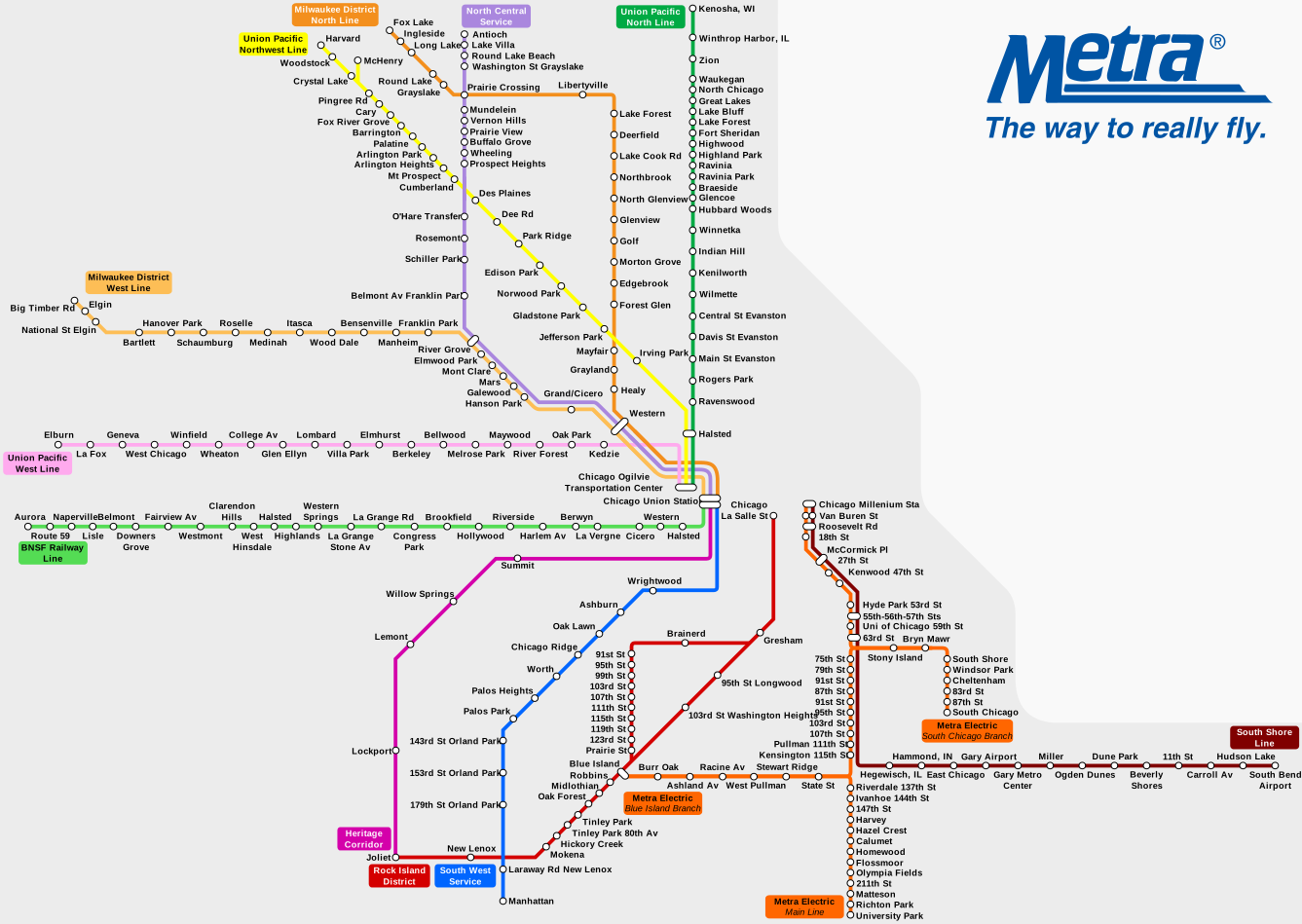
Toronto also has more than double the bus ridership, which also helps explain its subway success because a lot of bus riders transfer onto the subway. Both cities have impressively long commuter rail networks covering much of their region. Metra in Chicago is a little longer but has a little less ridership than Toronto’s GO Trains, at least post-pandemic. All GO Train lines connect at Union Station in downtown Toronto for easier cross-region trips while Chicago’s Metra lines have four different terminus stations downtown that can be up to a 30 minute walk from each other. If you want more on transit in the two cities, Reece Martin has a series we’ll link in the description where he covers other differences like Toronto’s more extensive night bus system.
Highways
Chicago has more highways: four that come close to downtown versus two in Toronto. This probably makes it harder for transit to compete but also really separates neighbourhoods. Chicago is awesome for dense, lively, interesting neighbourhoods but they often have dead zones in between due to highways or large arterial roads. Toronto was fortunate to escape the downtown highway craze with its urban fabric much more intact than most American cities.
Cycling
Over the past ten years, Toronto has made a lot of progress on cycling. It augmented subway corridors like Bloor and Yonge with bike lanes and very recently it’s installed some really high-quality protected infrastructure on streets like College and Wellington. There are still lots of gaps and you have to plan your route to avoid danger in a way that isn’t the case in the European cycling powerhouses but Toronto is clearly heading in the right direction.
Chicago isn’t a city we would have associated with cycling but to our surprise, it’s actually in a similar place: not exactly a “cycling city” yet but it’s made some pretty good progress. The 606 or Bloomingdale Trail is an old elevated freight rail corridor that was converted into a linear park and active transportation route. It’s four-and-a-half kilometres or two-and-a-half miles long and it’s an A+, family-friendly experience. There are even plans to extend it in 2025.
We also saw new bike corridors on Clark Street, Kedzie Avenue, and Milwaukee Avenue, plus older ones like Dearborn Street downtown. Some of these even had protected bike intersections, which separate cyclists from car traffic as much as possible through intersections. This is a really important part of bike infrastructure that’s so often forgotten in North America. We encountered four of these in Chicago and while that’s not really that many, it’s more than we’ve seen in any North American city aside from our former home of Ottawa and that’s pretty cool.
Chicago’s bike share is called Divvy, and it recorded 6.6 million trips in 2023, which is a bit higher than Bike Share Toronto’s 5.7 million. That might actually be the third most-used bike share system in the US and Canada, after New York and Montreal. We also saw a decent number of cargo bikes in Chicago, especially near the Bloomingdale Trail.
Traffic safety
Chicago was a better pedestrian experience than our last US trip to Miami, although we still had some problems, especially at crosswalks where drivers don’t seem to care about stopping. Strong Towns has a good video on crosswalk safety that uses some examples on Chicago that we could relate to. Interestingly though, the actual traffic fatality numbers from last year show that Chicago is somewhat more dangerous for pedestrians but a lot more dangerous for drivers.
Wealth and segregation
Chicago is a wealthier metro area than Toronto: median incomes are about 35% higher. It’s also substantially more segregated. A 2015 report found that Chicago is one of the most segregated cities in the US in terms of income, education, and class, and that Toronto is less segregated than every single large metro area in the US. Toronto is also less racially segregated than Chicago. Chicago has areas, especially on the south and west sides, that struggle with poverty, crime, and disinvestment at a scale and concentration that just doesn’t exist in Toronto, despite Toronto being a poorer city on average. You can see this in everything from the urban environment, where parts of Chicago have vacant lots even near transit, to health outcomes: Chicago has much more neighbourhood variation in health problems like low birth weights. Toronto is a very diverse city and metro area, with half the population being born outside of Canada, and while we’re not going to pretend like it’s a perfect place without discrimination, disparities, or cultural conflict, generally speaking Toronto works pretty well and is considered a success of multiculturalism.
Waterfront
Toronto and Chicago have a similar position on the Great Lakes: Lake Ontario and Lake Michigan, respectively. Both cities are separated from the lake by rail corridors and a road called Lake Shore Boulevard in Toronto or Lake Shore Drive in Chicago. Chicago has more destinations directly on the lakefront in terms of parks and beaches while Toronto offers more secluded park and beach space on the Toronto Islands and Tommy Thompson Park. Chicago also has a river going through downtown that’s really nice for its riverwalk and architecture boat tours. The Toronto equivalent is probably the ravines, which are pretty different but nice in their own way.
Sports
Toronto does pretty well for downtown, transit-accessible sports, especially compared to a lot of US cities that have their stadiums in seas of parking in the suburbs. But Chicago has something really interesting: Wrigley Field, home to the Chicago Cubs baseball team, is outside of downtown but still in the middle of a dense, residential neighbourhood. We saw it on game day — baseball has a lot of games — and it was a pretty cool experience.
Conclusion
We had a lot of fun in Chicago. People say the two cities are similar and broadly speaking they are, but they also feel very complementary. They excel in different areas and have a lot to learn from each other. We’d like to see Chicago take lessons on train frequency, bus service (especially in the suburbs), and transit-oriented development. And while we’re aware you can’t just snap your fingers and undo a century of segregation, Toronto is a pretty good example of successful multiculturalism. It shows that concentrated crime, disinvestment, and poverty are not inevitable outcomes of a diverse metropolis.
But Toronto also has a lot to learn from Chicago. It should be looking to match or beat the length of Chicago’s rapid transit. It shouldn’t be afraid of elevated trains, especially with newer technology. Toronto should learn that density means more than just towers near transit. Chicago’s low- and mid-rise apartments within neighbourhoods add a lot to the city both in terms of housing options and architecturally. Probably due to its age, Chicago also feels like it has a much better sense of itself as a big city that takes pride in its architecture, skyline, and importance. A lot of Toronto residents and politicians still seem to see themselves as living in a provincial backwater, almost being embarrassed or derisive about condos and development, even expressing nostalgia for the parking-lot-filled downtown of 30 years ago. Chicago isn’t immune to NIMBYism, and it’s (quote-unquote) “lucky” to not be facing as much demand pressure as Toronto. But the specific kind of NIMBYism in Toronto feeds on an inability to recognize that Toronto is a big city that needs big city housing and transportation solutions.
 Oh The Urbanity!