
This is Calgary, Alberta, home to the world’s largest outdoor rodeo and the biggest concentration of oil and gas companies in Canada. Its sister city to the north is Edmonton, whose hockey team is appropriately called “the Oilers”. Would you believe us if we said that the two big cities in Alberta — a province associated with cowboys and oil — are more “urbanist” than you thought? Would you believe that this is actual, verified footage from Edmonton? In this video we’re going to cover the underappreciated urbanism of Canada’s fifth and sixth biggest metro areas and talk about the fundamental challenge for urbanism in a place like this.
When people hear Calgary and Edmonton they typically think of low-density suburbs sprawling into the vast unobstructed openness of the Canadian prairies, but these two cities are actually denser than you’d expect for North America, especially given their populations. Calgary has a population of 1.3 million in the built-up urban and suburban parts of the city, while Edmonton is a bit smaller. The six most comparable cities in the US by population are Milwaukee, Providence, Jacksonville, Salt Lake City, Nashville, and Raleigh. If we look at how much land these cities take up — developed area, not city boundaries or metro area — there’s a stark difference between Calgary, Edmonton, and Salt Lake City versus the other US cities, which take roughly twice as much land for the same population. We could talk about the high-rises in Calgary or the new townhouses in Edmonton but a big difference is in the suburbs. Here’s a typical neighbourhood on the edge of Calgary. Nashville has variation but a lot of its suburbs look like this.
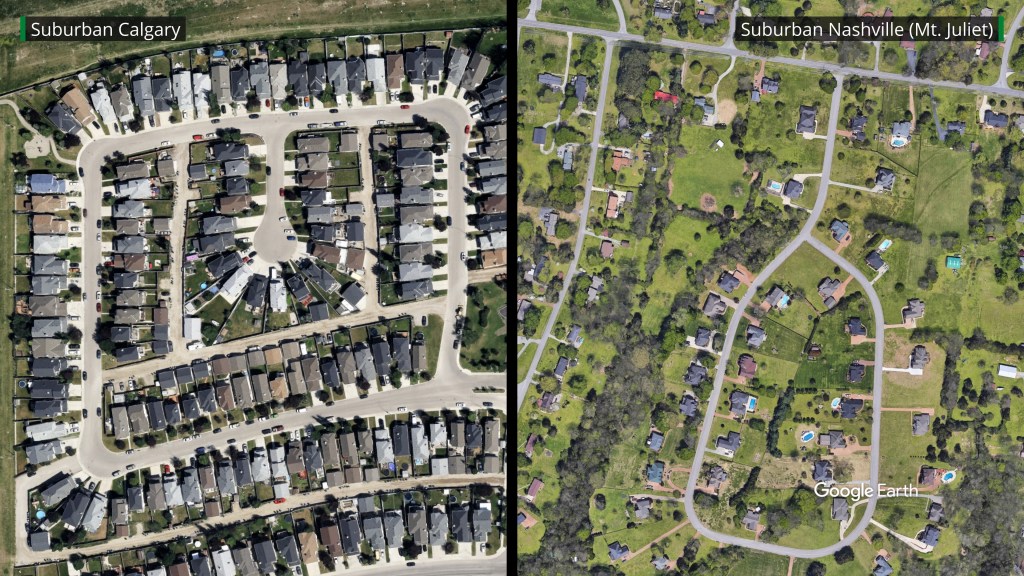
Calgary on the left is dense enough that you wonder why they didn’t just build townhouses while suburban Nashville feels almost rural. Same thing with the suburban edge of Edmonton versus Providence or Jacksonville or Milwaukee. This isn’t entirely a Canada versus US thing because many parts of the US (like Salt Lake City) have more compact suburbs too.
Calgary and Edmonton also punch above their weight in transit ridership. Both have successful light rail systems with ridership numbers comparable to bigger systems in much bigger cities. In the 70s, Edmonton realized it couldn’t afford to build highways through downtown and instead decided to build transit. Modeling the system to a large extent on Frankfurt, Germany, with construction and operations lessons from Philadelphia and Cleveland, Edmonton built North America’s first modern LRT system. Today it sees about 85,000 trips per day, which is actually higher than Portland’s MAX and San Francisco’s Muni Metro, both longer light rail systems. Calgary’s LRT came a few years later and is an even bigger overperformer, carrying an impressive 265,000 people per day by the end of 2023, making it the most-used light rail system in the US and Canada. That ridership is actually higher than Muni Metro (San Francisco’s light rail) combined with BART (the Bay Area’s rapid transit, regional rail hybrid), even though those systems together are substantially longer and serve a much more populated metro area. Why do Alberta’s light rail systems perform so well? It helps that the cities aren’t quite as spread out as people think, but also the service is pretty good. Trains come every 3 to 6 minutes during rush hour, depending on the city and line, with frequencies no lower than every 15 minutes off peak. Trains are also pretty fast, receiving signal priority and even crossing gates when they have to interact with cars. Like many other LRT and metro systems in Canada, they also drive a lot of ridership from strong bus connections. Calgary has four bus rapid transit lines too although the off-peak frequencies in particular leave a lot to be desired. Both cities have some key destinations like stadiums served by rail and Calgary in particular drives a lot of ridership from a high concentration of jobs downtown without enough parking for everyone. It’s a strange, strange world when the oil industry office jobs of Calgary are more concentrated in downtown, transit-accessible locations than the tech industry of the Bay Area, which likes its sprawling suburban office parks far from transit.
Both Calgary and Edmonton have the problem of a commuter-focused downtown that can feel dead and sometimes sketchy after hours. Edmonton’s downtown definitely fills up for hockey games though and we saw Chinook Blast, a winter festival in Calgary, with skating, music, and dragon fire. Calgary has a pedestrian street downtown where we were surprised to see a cargo bike within the first five minutes of leaving our hotel. One street over from Calgary’s pedestrian street is its transit mall. Instead of tunneling its LRT through downtown like Edmonton, Calgary decided to save money by dedicating a downtown street to transit. It’s not exactly a pedestrian destination but it’s a lot more pleasant than the wide streets dedicated to cars and it’s great for visibility of transit because the volume of trains is very high. Maybe Toronto can learn a thing or two for King Street? Maybe one of these vehicle traps? Edmonton is actually trying the surface route through downtown approach with its new Valley Line and the street transformation is really impressive, going from five lanes for cars to just one car lane between the train tracks and a bike corridor, although only part of the corridor is done, and as we encountered, there are disadvantages to street-running trains too. Both cities have a lot of extremely wide roads through their downtown, which are pretty unpleasant, although wide roads are easier to retrofit for cyclists and transit than the large highways that go through a lot of other cities’ downtowns, which Calgary and Edmonton were lucky enough to avoid. Calgary also has the “plus 15” system of walkways between buildings. It gets criticized for taking away from street life and we get the concern but it’s also understandable in a cold climate and not that different from underground systems in other cities. At least the plus 15 system gives people access to sunlight, versus the underground systems that don’t.
We had a fun time exploring some of the older, more urban neighbourhoods outside of downtown like Strathcona in Edmonton and Kensington and the Beltline in Calgary, which had a cool mix of housing and were pretty lively, especially with the unseasonably warm weather hovering around five degrees above freezing in February. While biking around in this mild European winter weather on a pair of Dutch bikes we came across this very unexpected strip mall in Edmonton.
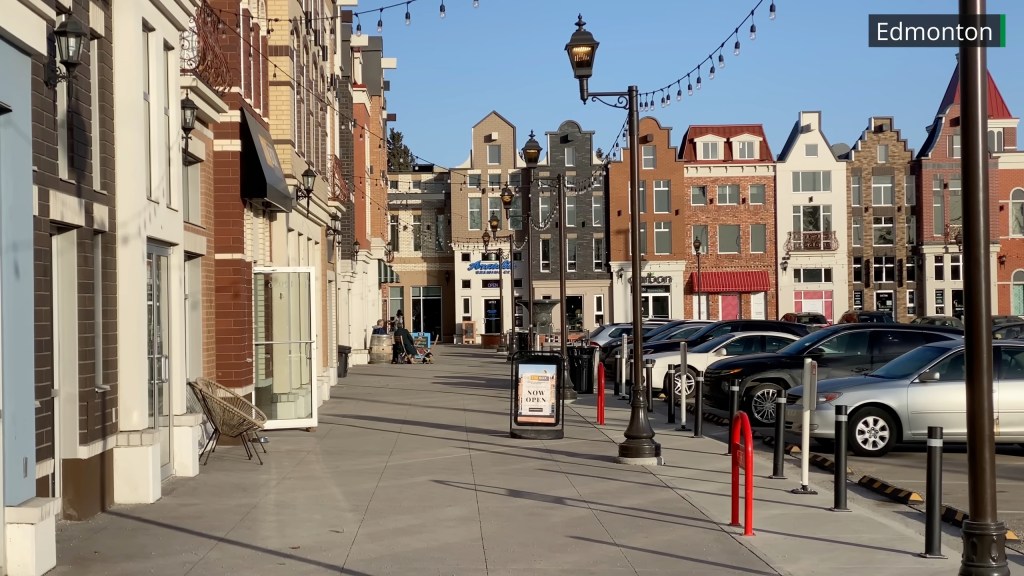
Architects usually don’t like copying styles from other places like this, seeing it as inauthentic, but we found it fun and unique. It’s nice when cities try crazy things and see how they work out. Apparently it’s become something of an Instagram destination. We just wish the parking was less prominent and that it wasn’t named “Manchester Square” when it’s clearly Dutch, not British, inspired. We’re told it’s a reference to “Manchester” being an old name for the neighbourhood, but it still feels like a disconnect. Despite the large parking lot, it is very accessible by bike though.
We spent more time on a bike in Edmonton than we did in Calgary so we can speak more to the experience there but we were actually decently impressed. Lots of routes were labeled for winter priority clearing and many of them went through parks that broke up the road network and acted like traffic filters. We saw progress on one corridor, 132nd Avenue, that’s undergoing a major 5-year overhaul of the street that will include one of the nicest bike corridors on the continent. To be clear though, the bike networks in both Calgary and Edmonton are still in their infancy. We’re talking about pockets of bike-friendliness rather than a built-out system that can consistently and predictably move people around the city like the transit networks do. There are tons of gaps in coverage and we saw lots of people biking on the sidewalk. Edmonton in particular is actively improving here though, with a $100-million investment into bike infrastructure over the next few years. Outside of the on-street corridors, both cities reminded us of Ottawa in that they rely on the river recreational pathway system to fill in some of the gaps. That typically means great quality pathways with less than ideal routes, especially for transportation. The river valleys are amazing for views of the downtown skyline though, where both cities punch above their weight. We think Calgary’s skyline is better overall but Edmonton does have the tallest building in Canada outside of Toronto.
Overall, we found these two Albertan cities to be underrated, given their reputations and the comparisons with the sprawliest US cities. Even people from these two places often don’t realize that they punch above their weight on things like transit ridership. At the same time, their reputations don’t come from nowhere. Both cities experienced the vast majority of their development in the post-war suburban era. These are car-centric cities that made the geometrically practical and fiscally prudent decision to get commuters downtown by trains fed by buses rather than destroying large parts of their downtowns with highways. That’s great, but it doesn’t mean they’ve oriented other parts of city life around transit, walking, or cycling necessarily. Even if you can take transit to work, there’s a pretty good chance you’re going to want a car for other destinations unless you live in a few central neighbourhoods, and even then. We talked to lots of people who moved there from other cities and nearly all ended up buying at least one car for their household.
Fundamentally the biggest challenge for (or limitation on) urbanism here is that any good density, walkability, or transit that you find feels like a bubble. Partly this is just being a mid-sized North American city where the most walkable neighbourhoods just don’t feel that big: geographically, culturally, or politically. We felt the same thing in Ottawa. But another part is being on the vast Canadian prairies where every other sense of “city life” is really far away. In Ottawa you can take the train to Montreal in two hours or Toronto in five. In Edmonton the closest “big city” is Vancouver, a 33-hour train ride with two trains per week. Calgary doesn’t have any passenger train connections at all. Sure, you can fly, but the point is that these two cities — especially the parts that are the most walkable and transit-accessible — are islands of urbanism in a vast region that is very rural and very spread out. The idea that “North America isn’t Europe!” often comes up and it’s places like the Prairies that really make you think: yeah, in some ways North America really isn’t Europe. High-speed rail has been proposed between Calgary and Edmonton: it might very well be viable, especially when you consider how fast these cities are growing. But it would still be a single line between two cities, without any of the connections and network effects that you get from denser rail networks in Europe or even the northeast corridor in the US. That reduces the usefulness and ridership potential but also the political support. Why would someone near Lloydminster want their tax dollars going towards high-speed rail connecting the big cities?
The challenges to urbanism here are as much cultural and political as practical. The Prairies feel like they have a very sharp urban/rural divide where once you go outside the cities, things turn very rural very fast and stay that way, with hundreds or thousands of kilometres of sparse settlements where people understandably feel an attachment to cars. Cars are important in rural areas in every developed country but in a lot of European countries even a farm might be within cycling distance of a dense town that has a train or at least a bus that gets you into a city. You rely on a car for lots of things but transit and density aren’t alien to you. The difference between cities and rural areas feels more extreme in a place like Canada, especially the wide open Prairies. You have a lot of people in rural areas or small cities or even the outer areas of bigger cities who might have never used public transit in their lives. They’re more likely to see investments into transit or cycling as irrelevant to them, out-of-touch with the needs of everyday people, or even a sinister attack on their way of life. These attitudes exist everywhere but they’re going to be stronger in more spread-out regions. And the elephant in the room is that the oil and gas sector makes up more than 20% of Alberta’s economy. Those anti-urban attitudes are supercharged in a region where a lot of people’s livelihoods rely, directly or indirectly, on fossil fuels. Redesigning streets and investing in public transit can come across not just as a threat to how you get around but also how you feed your family and pay your mortgage. From our perspective, the fundamental challenge of Prairie urbanism is fighting for things like density, walkability, and transit in a cultural and political environment that can be very unfriendly to cities and city things.
It’s no surprise that Alberta has been a hotspot for protests and controversy over conspiratorial interpretations of 15-minute cities, where people apparently fear that they will be locked into their neighbourhood through an elaborate system of fines and permits. A poll last year found that Alberta was the region of Canada most likely to have heard of 15-minute cities and least likely to support the concept. One petition with more than 3,000 signatures highlighted a worry that rural dwellers won’t be able to come into the city for the market. That backlash hasn’t affected any policy as far as we can tell but it’s responses like this that make it harder, culturally and politically, to build cities that prioritize people over cars. See another Prairie city: Winnipeg, whose main intersection downtown has been closed to pedestrians for decades in order to keep high traffic flow. Downtown residents favoured opening it in a 2018 referendum but they were overridden by the suburbs and rural outskirts. It’s harder to build people-friendly urban neighbourhoods when you can be overruled by the more numerous car-centric suburbs and rural areas who see your neighbourhoods mainly as a place to drive through. (Six years later in 2024, Winnipeg city council actually voted to open the intersection anyway, but because the underpass system is becoming too expensive to repair, not necessarily out of any care for pedestrians.)
One final thing: the fact that Calgary and Edmonton are denser than you think is interesting but it doesn’t mean they’re meeting housing demand. Calgary in particular has a problem: their housing is about 50% more expensive than Edmonton and they’ve been slower to enact zoning reform. A claiming that it would “ruin” their neighbourhood. The new multi-family housing wouldn’t be “affordable” enough at the same time that it would “threaten” the value of their home. You can find these contradictory and exclusionary attitudes in every city but Edmonton has done a better job of side-stepping them even though Calgary’s housing affordability problem is more acute, which means that Calgary actually should have been faster and more ambitious on reform.
We had a pretty great time in Alberta, thanks to invitations from the Winter Cycling Congress in Edmonton as well as More Neighbours Calgary and Strong Towns Calgary, not to mention the unseasonably warm weather that allowed us to spend a lot of time exploring around and filming. Calgary and Edmonton are interesting because they punch above their weight in things like transit and even density while existing in an environment, the vast Canadian prairies, that can be quite challenging (culturally, politically, and practically) to things like density, transit, and city life.
 Oh The Urbanity!